
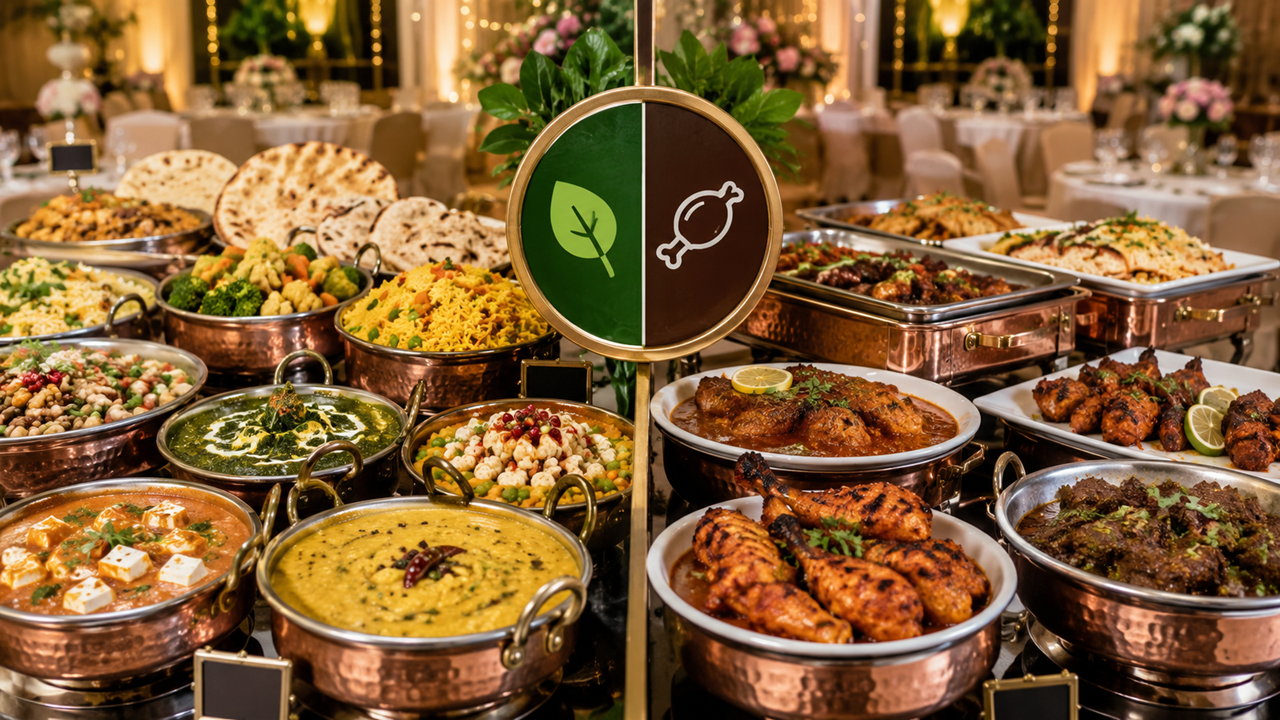
Vegetarian vs Non-Vegetarian Catering: Planning a Mixed-Guest Wedding Menu
Weddings bring together many people. There are grandparents, cousins, friends from school, friends from work, and neighbours. Every one of these guests may have a different taste in food. Some guests eat only vegetarian food. Some guests eat both vegetarian and non-vegetarian food. This mix of food habits is very common in Indian weddings, and it can feel confusing when you sit down to plan the menu.
If you are planning a wedding this year, you already know that food is one of the biggest topics of conversation. Guests remember the food long after the wedding is over. A good catering plan makes everyone happy, keeps the event smooth, and does not break your budget. A poor plan can lead to long queues, mixed-up dishes, or guests who feel left out because there was nothing for them to eat.
This blog will walk you through everything you need to know about planning vegetarian and non-vegetarian catering together for a mixed-guest wedding. We will talk about guest planning, menu ideas, kitchen setup, budget, serving style, and common mistakes. By the end, you will have a clear picture of how to make your wedding food a success story instead of a stress story.
Why This Topic Matters Today
Food habits in India are changing every year. Many families still follow strict vegetarian traditions, especially at religious functions. At the same time, more young people today enjoy non-vegetarian food and expect it to be part of a wedding menu. When two families come together through marriage, their guest lists often carry both these food habits.
This is why catering planning cannot be a simple, one-size-fits-all task anymore. Couples and families need to think carefully about how many guests eat what kind of food, how the two menus will be prepared without mixing, and how the food will be served so nobody feels awkward or ignored.
Getting this right is not only about taste. It is also about respect. Serving proper food to every guest, according to their choice, shows that the hosts have thought about their comfort. This small effort often becomes one of the most talked-about positive points of the wedding.
Step 1: Understand Your Guest List First
Before you talk to any caterer, sit down with your family and go through the guest list. Try to divide the list into three simple groups: guests who eat only vegetarian food, guests who eat both vegetarian and non-vegetarian food, and guests whose food habit you are not sure about.
You do not need an exact number for each guest. A rough idea is enough. For example, if you expect 400 guests and you know that about 150 of them are strictly vegetarian, this number will help you and your caterer decide how much of each type of food to prepare.
It also helps to think about where the guests are travelling from. Guests coming from small towns or from families with strong traditions may lean more towards vegetarian food. Guests from cities or younger age groups may prefer a mix. This is not a rule, but it can give you a helpful starting point.
Once you have a rough split, share this information with your caterer early. Caterers who have handled many weddings can guide you on the usual ratio they see, such as sixty percent vegetarian and forty percent non-vegetarian, or the opposite, depending on the community and region.
Step 2: Talk Openly With Your Caterer
Once you have a sense of your guest list, the next step is a detailed conversation with your caterer. Do not assume that the caterer already understands your needs. Explain clearly that you want both vegetarian and non-vegetarian food, and that the two should never touch or mix at any stage.
Ask the caterer direct questions. Do they have separate cooking areas for vegetarian and non-vegetarian dishes? Do they use separate vessels, spoons, and chopping boards? Do they have separate kitchen staff assigned to each type of food? These questions are important, especially for guests who follow strict vegetarian diets for religious reasons.
A good caterer will have clear answers to these questions and will already follow a system to avoid mixing. If a caterer seems unsure or gives vague answers, it may be a sign to look for another option, especially if this matter is important to your family.
Step 3: Plan Separate Counters and Live Stations
One of the best ways to manage a mixed-guest wedding menu is to set up separate food counters. Keep the vegetarian counters at one side of the venue and the non-vegetarian counters at another side. This helps guests find their preferred food quickly and reduces confusion near the buffet line.
Live counters have become very popular at Indian weddings. A live counter is a small stall where a chef cooks a dish in front of guests, such as chaat, dosa, pasta, or grilled kebabs. If you are adding live counters, make sure the vegetarian live counters and non-vegetarian live counters are placed far apart, with different chefs and different cooking tools.
Clear labels are also very important. Use simple signboards or small table cards that say "Pure Vegetarian" or "Non-Vegetarian" in bold letters. Many caterers use a green dot symbol for vegetarian food and a brown or red dot symbol for non-vegetarian food, similar to what is printed on packaged food. This small step avoids confusion and makes guests feel confident about what they are eating.
If your venue has enough space, you can even use a small physical gap or a decorative partition between the two sections. This is a simple way to show respect for guests who prefer to stay completely away from non-vegetarian food, even visually.
Step 4: Build a Balanced Vegetarian Menu
A vegetarian menu should never feel like a smaller or simpler version of the non-vegetarian menu. It should be planned with the same care and variety. Guests who eat only vegetarian food should never feel like they are getting fewer choices.
Start with a good starter selection. Popular choices include paneer tikka, hara bhara kebab, crispy corn, and stuffed mushrooms. For soups, a simple tomato soup or a sweet corn soup works well for most Indian weddings.
For the main course, include a mix of gravies and dry dishes. A rich paneer dish, a dal preparation, a seasonal vegetable curry, and a simple dal makhani are common favourites. Add regional touches if your family has a specific cuisine background, such as Rajasthani gatte ki sabzi, Bengali chana dal, or South Indian sambar and rasam.
Rice and bread items matter a lot too. Offer at least one flavoured rice, such as jeera rice or vegetable pulao, along with plain rice. For bread, naan, roti, and kulcha are safe and popular choices.
Do not forget the salad and raita counter. A fresh salad bar with cut vegetables, sprouts, and a simple dressing adds a healthy touch. Raita, whether boondi or vegetable, is almost always appreciated at Indian weddings.
Finally, plan a strong dessert section. Gulab jamun, rasmalai, and a live dessert counter such as a chocolate fountain or ice cream stall are always crowd-pleasers.
Step 5: Build a Balanced Non-Vegetarian Menu
A good non-vegetarian menu should also have variety, without being too heavy or too spicy for every guest. Start with lighter starters such as chicken tikka, fish amritsari, or mutton seekh kebab. These are familiar flavours that most Indian wedding guests enjoy.
For the main course, offer at least one chicken dish, one mutton dish, and one fish or seafood dish, depending on your budget and the taste of your community. A butter chicken or chicken curry is almost always a safe and popular main course choice. If your family enjoys mutton, a rogan josh or mutton curry adds a festive touch.
Rice pairs beautifully with non-vegetarian dishes too. A chicken biryani or mutton biryani counter is often one of the most loved parts of an Indian wedding buffet. Keep a separate serving spoon and plate stack at this counter so it does not get mixed with vegetarian rice dishes.
Remember that some guests who eat non-vegetarian food may still want to try vegetarian dishes as well. This is why it helps to place the vegetarian and non-vegetarian counters close enough for easy movement, but still clearly separated with signs and space.
Step 6: Keep the Kitchen Separate and Clean
Behind every good wedding buffet is a well-organised kitchen. If your caterer is preparing both vegetarian and non-vegetarian food, insist on separate cooking zones. This means separate stoves, separate cutting boards, separate storage areas in the refrigerator, and separate staff wherever possible.
This is especially important for guests who are strict vegetarians. Even a small mix-up, such as using the same spoon for both types of food, can upset guests and create an uncomfortable situation at the wedding. A responsible caterer will already follow hygiene and separation rules, but it does not hurt to confirm this in writing before the big day.
Ask your caterer to label containers clearly in the kitchen itself, not just at the serving counter. This reduces the chance of human error during a busy, high-pressure wedding day when many dishes are being prepared at once.
Step 7: Plan Your Budget Wisely
Non-vegetarian dishes, especially mutton and seafood, usually cost more than vegetarian dishes. This means your total catering budget will depend heavily on how much non-vegetarian food you plan to serve, and how many guests are expected to eat it.
A smart way to plan your budget is to use your guest list data from Step 1. If you know that a smaller portion of guests eat non-vegetarian food, you can plan a slightly smaller quantity of non-vegetarian dishes without cutting down on variety. This helps you offer good quality food across both menus, instead of a large quantity of average food.
Always ask your caterer for a written quotation that lists the price per plate for vegetarian and non-vegetarian food separately. This helps you understand exactly where your money is going and makes it easier to make small changes if your budget is tight.
It also helps to ask about wastage policies. Weddings often see food wastage because caterers prepare more than needed. Discuss with your caterer how they estimate quantities, and consider donating extra food to a local shelter instead of letting it go to waste.
Step 8: Think About Serving Style
There are usually three serving styles at Indian weddings: buffet service, plated service, and table service with servers walking around. Buffet service is the most common because it allows guests to choose exactly what they want, which works very well for a mixed vegetarian and non-vegetarian crowd.
If you choose a buffet, make sure there are enough serving staff at each counter to guide guests and avoid long queues. Guests get tired quickly if they have to stand in line for a long time, especially at large weddings with many food counters.
Plated service can feel more elegant, but it requires guests to choose their meal type in advance, usually through the invitation card or a simple RSVP form. This works well for smaller, more formal weddings, but can be difficult to manage for very large Indian weddings with hundreds of guests.
Whichever style you choose, make sure your serving staff clearly understands which trays or plates belong to which menu. Mixing trays between vegetarian and non-vegetarian sections, even by mistake, can undo all your careful planning.
Step 9: Communicate Clearly With Your Guests
Good communication does not stop with your caterer. It should also reach your guests. If you are sending invitation cards, you can add a small note asking guests to mention their food preference, especially if you are planning a sit-down dinner with a fixed menu.
For buffet-style weddings, this step is less critical, but it still helps to know a rough number in advance. A simple message in your family WhatsApp group or a short line on your wedding website works well for this purpose.
On the wedding day itself, make sure your venue has clear signs directing guests to the right counters. Elderly guests, in particular, appreciate clear labelling and helpful staff who can guide them without confusion.
Sample Menu Ideas for a Mixed-Guest Wedding
Here is a simple sample menu you can use as a starting point, which you can adjust based on your region, budget, and family traditions.
Vegetarian Starters: Paneer tikka, hara bhara kebab, crispy corn, vegetable spring rolls.
Non-Vegetarian Starters: Chicken tikka, fish amritsari, mutton seekh kebab.
Vegetarian Main Course: Paneer butter masala, dal makhani, seasonal vegetable curry, jeera rice, vegetable pulao, naan, roti.
Non-Vegetarian Main Course: Butter chicken, mutton curry, chicken biryani.
Sides: Boondi raita, fresh salad bar, papad, pickle.
Desserts: Gulab jamun, rasmalai, live ice cream counter, gajar ka halwa.
This sample menu can be expanded or reduced based on your guest count and budget. The key idea is to keep both menus balanced in variety, so no guest feels like their food choice was an afterthought.
Common Mistakes to Avoid
Many families make small planning mistakes that can be easily avoided with a little extra care. One common mistake is not asking the caterer clearly about separate cooking and serving arrangements, assuming it will automatically happen.
Another mistake is placing the vegetarian and non-vegetarian counters too close together without clear labels, which leads to confusion, especially in crowded weddings where guests are moving quickly between counters.
Some families also under-plan the vegetarian menu, thinking it needs fewer dishes than the non-vegetarian menu. This can leave vegetarian guests with very limited choices, especially if they arrive later in the event when some dishes may have run out.
Lastly, many hosts forget to plan for guests with specific needs, such as Jain guests who avoid onion and garlic, or guests with food allergies. If your guest list includes such guests, inform your caterer in advance so a few special dishes can be prepared for them.
Frequently Asked Questions
Question: Should I have completely separate caterers for vegetarian and non-vegetarian food?
Answer: It is not necessary to hire two different caterers. Most experienced wedding caterers in India already manage both menus together, as long as they follow proper separation of kitchen tools and staff. However, if you want extra assurance, you can ask for a written confirmation of their separation process.
Question: What ratio of vegetarian to non-vegetarian food should I plan?
Answer: This depends on your guest list and regional habits. A common starting point is sixty percent vegetarian and forty percent non-vegetarian, but your caterer can guide you better once they know your specific guest mix.
Question: Is it rude to ask guests about their food preference?
Answer: Not at all. Asking guests about their food choice, especially for a sit-down dinner, is seen as thoughtful and considerate. It helps the hosts plan better and shows guests that their comfort matters.
Question: How can I avoid food wastage at my wedding?
Answer: Work closely with your caterer to estimate quantities based on your actual guest count rather than a rough guess. You can also arrange for extra food to be donated to a local shelter or community kitchen after the event.
Question: How far in advance should I finalise the wedding menu?
Answer: It is best to finalise your menu at least one to two months before the wedding date. This gives your caterer enough time to plan the kitchen setup, order fresh ingredients, and arrange the right number of staff for both the vegetarian and non-vegetarian counters.
Question: Can I include regional or fusion dishes in a mixed-guest wedding menu?
Answer: Yes, many couples today enjoy adding regional specialities or fusion dishes, such as a Chinese counter or a South Indian breakfast counter for morning functions. Just make sure that any fusion counter also follows the same rule of keeping vegetarian and non-vegetarian dishes clearly separate.
Choosing the Right Caterer for a Mixed Menu
Not every caterer has the same level of experience with large, mixed-guest weddings. When you are shortlisting caterers, ask to see photos or videos of counters they have set up at previous weddings. This gives you a real sense of how they separate and label their vegetarian and non-vegetarian sections.
It also helps to ask for references from recent clients who had a similar guest mix. A quick phone call to a previous client can tell you a lot about how smoothly the caterer handled a large, mixed crowd, and whether there were any complaints about food quality, mixing, or delays.
Before signing any contract, request a tasting session. Most professional caterers offer this service so you can personally check the taste, spice level, and presentation of both the vegetarian and non-vegetarian dishes before the final menu is locked.
Timing and Seasonal Considerations
The season of your wedding can also shape your menu choices. Summer weddings often benefit from lighter dishes, fresh salads, and cooling drinks like buttermilk or fresh lime water, along with lighter versions of both vegetarian and non-vegetarian curries.
Winter weddings, on the other hand, are a good time for richer dishes, warm soups, and heavier gravies, since guests generally enjoy heartier food in cooler weather. Seasonal vegetables and fresh seafood, where available, can also add a special touch to your menu depending on the time of year.
Keep the time of the function in mind as well. A daytime wedding lunch usually calls for a lighter, quicker menu, while an evening reception dinner gives more room for elaborate live counters and a longer dessert spread.
Conclusion
Planning a wedding menu for a mixed group of vegetarian and non-vegetarian guests may feel like a big task at first, but it becomes simple once you break it down into small steps. Start by understanding your guest list, communicate clearly with your caterer, keep the kitchen and serving areas separate, and build both menus with equal care and variety.
At the end of the day, food is one of the ways you welcome and thank your guests for being part of your special day. A thoughtful, well-planned menu, where every guest finds something they enjoy, adds warmth to the celebration and leaves a lasting good memory for everyone who attended.
With careful planning, open communication, and a caterer who understands your needs, you can create a wedding menu that brings together every guest, no matter their food choice, in one happy celebration.